

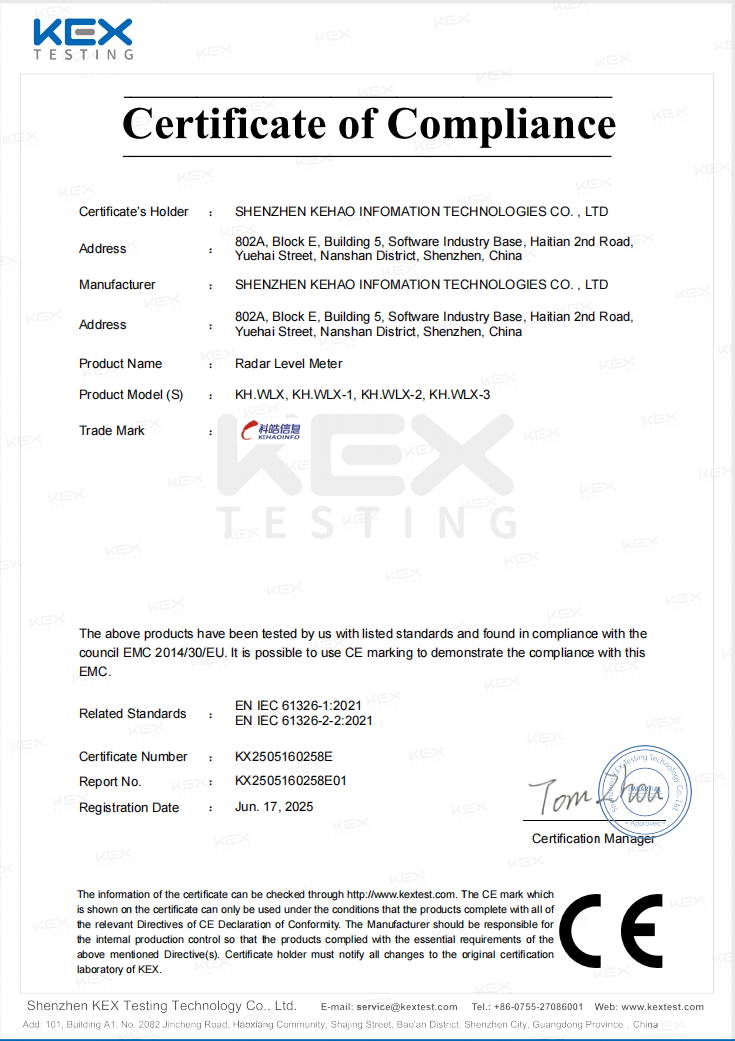
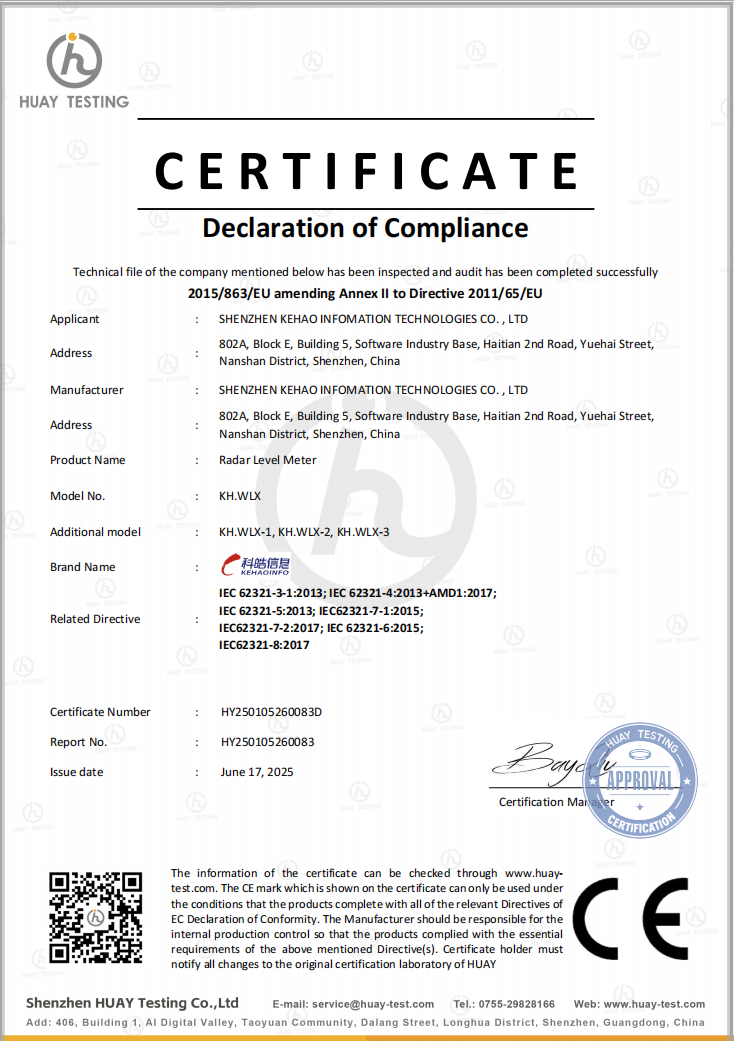
Product Certificate
Non-Contact Radar Water Level Sensor (FMCW) for River & Urban Flood Monitoring | IoT Water Level Meter
High-precision FMCW radar water level sensor for rivers, reservoirs, lakes, and urban drainage systems. Non-contact measurement with ±2 mm accuracy, ideal for flood monitoring and smart city IoT applications.
Product Manual (pdf)
Product Introduction
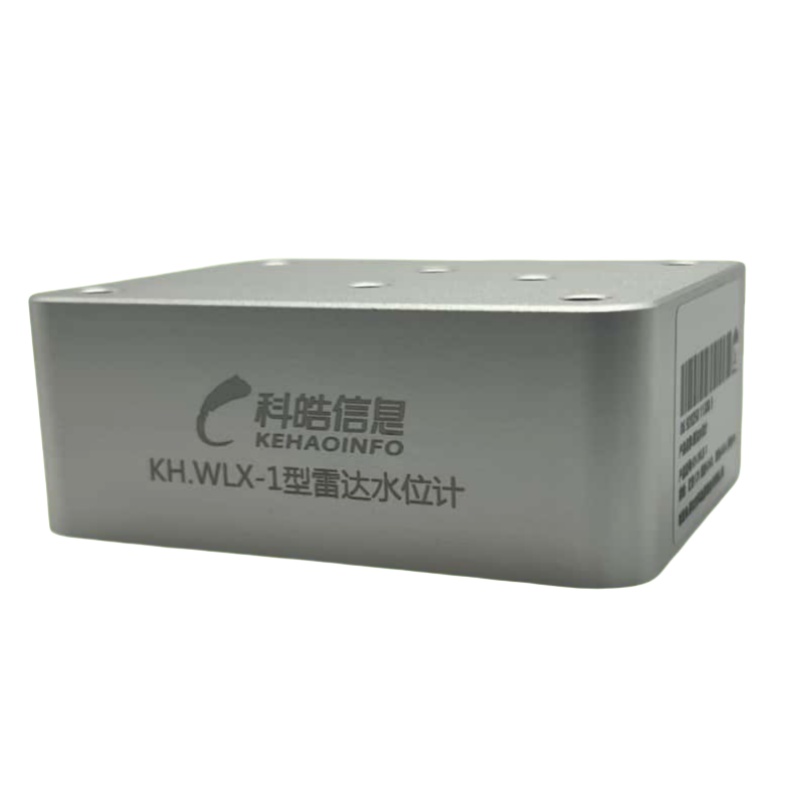
The KH.WLX Non-Contact FMCW Radar Water Level Meter is a high-precision hydrological monitoring device designed for real-time water level measurement in rivers, lakes, reservoirs, canals, and urban drainage systems.
Unlike traditional contact-based sensors, this radar system uses FMCW (Frequency Modulated Continuous Wave) technology to measure the distance to the water surface without physical contact. This makes it highly reliable in environments affected by rain, fog, waves, sediment, floating debris, or water pollution.
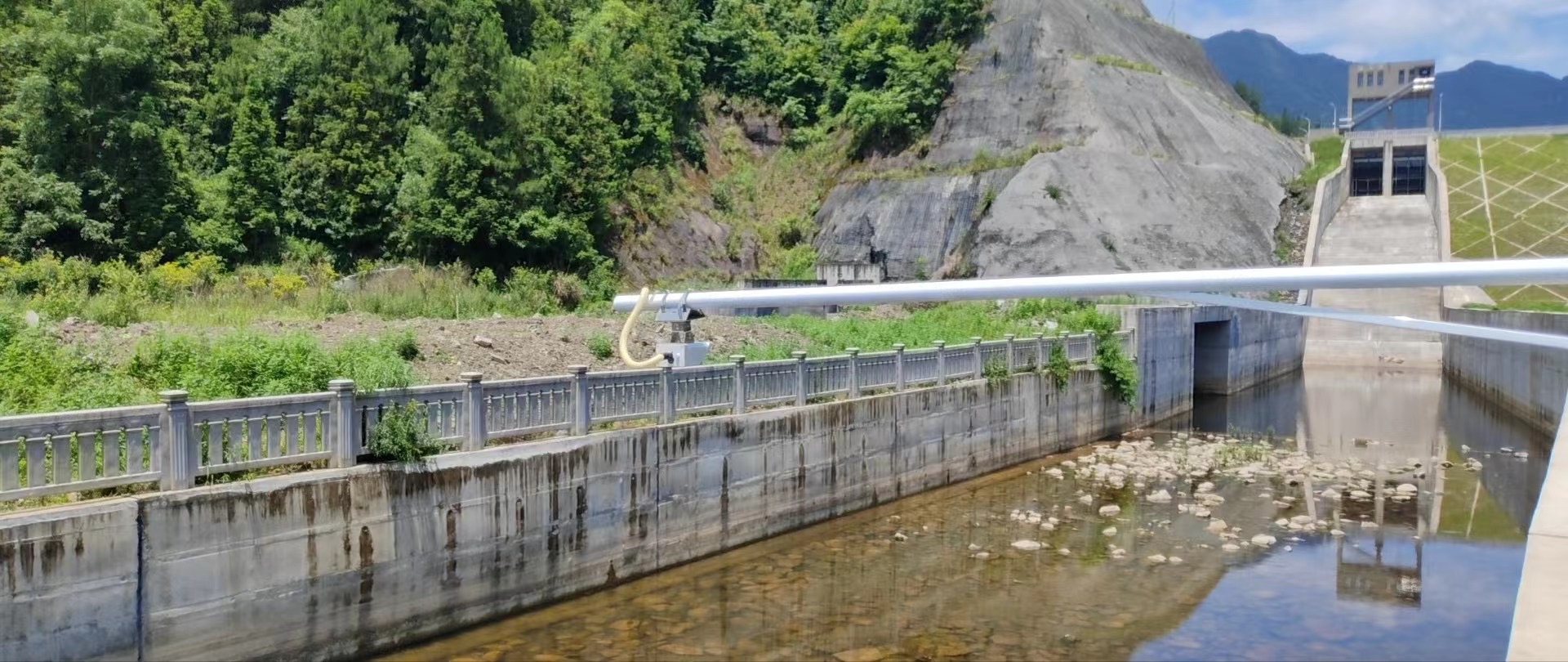
It is widely used in flood early warning systems, smart city drainage monitoring, river hydrology stations, and water resource management platforms, providing stable and maintenance-free operation for long-term deployments.
How It Works
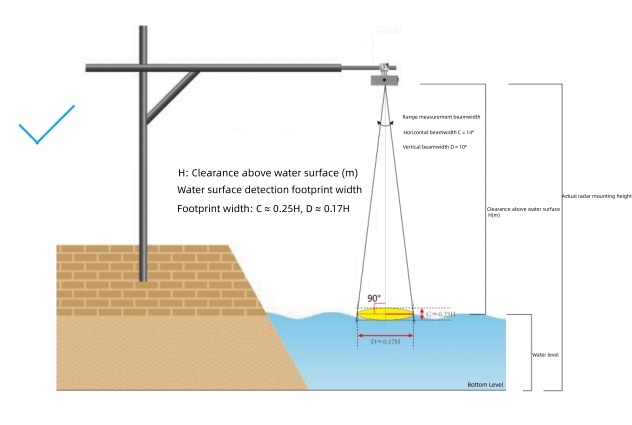
The radar emits continuous frequency-modulated waves toward the water surface. By analyzing the frequency shift of the reflected signal, it calculates the distance to the water level with high precision.
This non-contact approach ensures:
- No fouling or corrosion
- No sediment interference
- No mechanical wear
Key Features
1. Non-Contact FMCW Radar Technology
Provides accurate water level measurement without direct contact with water, eliminating fouling and maintenance issues.
2. Ultra-High Precision Measurement
Accuracy up to ±2 mm, with 1 mm resolution and fast response time as low as 100 ms.
3. Stable Performance in Harsh Environments
Unaffected by:
Rainfall
Fog
Waves
Floating debris
Sediment and water turbidity
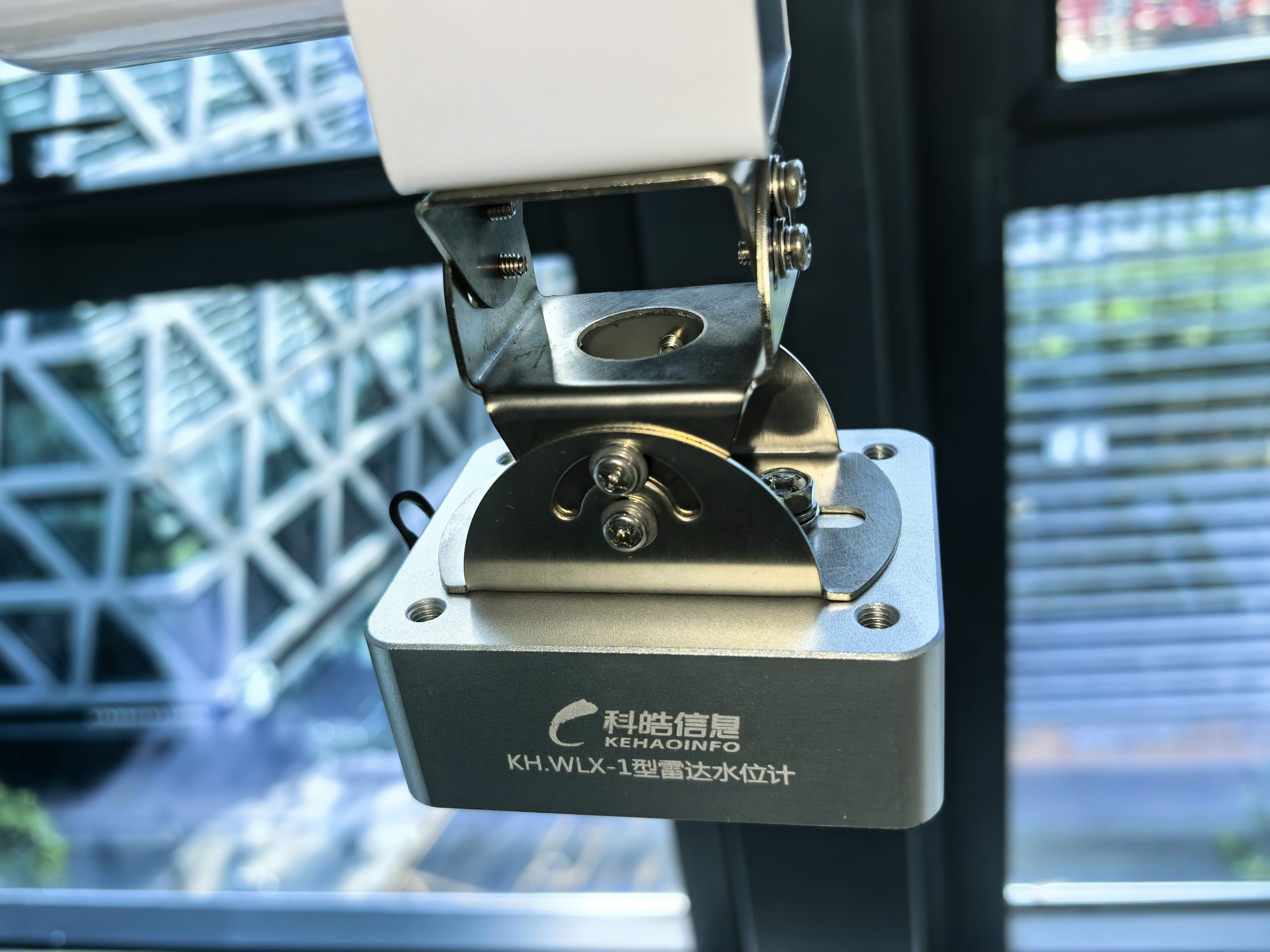
4. Compact & Easy Installation
Suitable for:
Bridges
Culverts
Narrow channels
Urban drainage pipelines
5. Industrial-Grade Protection
IP68 waterproof housing with anti-condensation and lightning protection for outdoor environments.
6. Low Power Consumption Design
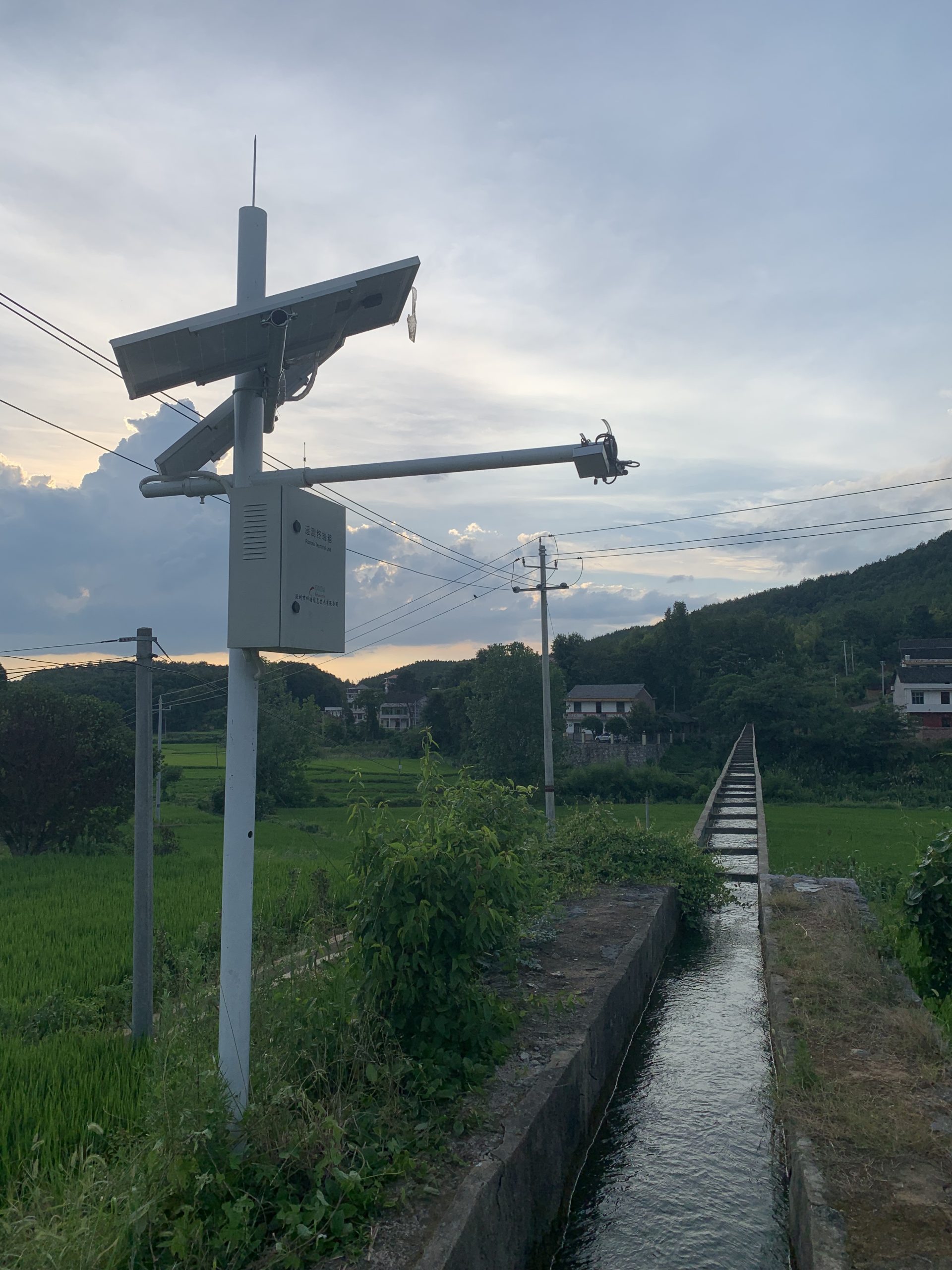
Supports solar-powered stations and unattended long-term deployment with intelligent sleep mode.
7. Strong Anti-Interference Capability
Stable operation in complex electromagnetic and urban environments.
8. Flexible Communication Interfaces
Supports RS485 with Modbus/ASCII protocols for easy IoT integration.
9. Multi-Frequency Radar Options
Available in 24 GHz / 60 GHz / 80 GHz versions for different installation heights and scenarios.
Application Scenarios
River & Reservoir Monitoring
Real-time hydrological data collection for water resource management.
Urban Flood Control Systems
Core component of smart city drainage and sponge city systems.
Stormwater & Sewer Monitoring
Used in underground pipelines and drainage networks for flood prevention.
Mountain Flood Early Warning Systems
Rapid-response monitoring for disaster prevention in high-risk regions.
Water Infrastructure Systems
Supports pumping stations, water supply networks, and wastewater treatment monitoring.
Technical Specifications
| Parameter | Specification |
|---|---|
| Distance Measurement Range | 0.15–10 m or 0.15–40 m optional |
| Measuring Accuracy | ±2 mm |
| Resolution | 1 mm |
| Startup Time | 100 ms |
| Working Voltage | 9–24 VDC (typical 12 V) |
| Working Current | 20 mA |
| Output | RS485 communication, default baud rate 9600 bps, ASCII / Modbus protocol switching |
| Transmitting Frequency | 24 GHz / 60 GHz / 80 GHz optional, bandwidth 4G |
| Output Power | 13–20 dBm |
| Beam Width | 14° (horizontal), 10° (vertical) |
| Operating Temperature | -45 ℃ to +85 ℃ |
| Protection Level | IP68 |
| Installation | Non-contact, compact, and maintenance-free |